Intro
Every change you make becomes real orders in real accounts
I'm Chris, one of the co-founders of Autopilot. A strategy that works in your own account can behave very differently when it lands in a thousand accounts of different sizes at different brokerages. Here are the mechanics that decide whether your Portfolio follows well, and the choices that respect them.
One thing first, because we're an SEC-registered investment adviser and I have to say it. Autopilot is the app. The actual investment advice comes from Autopilot Advisers, LLC. If you want the full legal version of anything in here, it's on our legal page.
Stocks and ETFs, long only. That's what a follower's brokerage account can hold through us. No options, no crypto, no shorts.
If your view on crypto is part of your strategy, you can express it through companies and funds tied to the sector, and several Pilots do. If your edge needs options or shorts, the platform can't carry it into follower accounts. Better to know that before you design around it.
By the numbers
Our difference
The mechanics that turn your strategy into follower accounts
1) Following is proportional
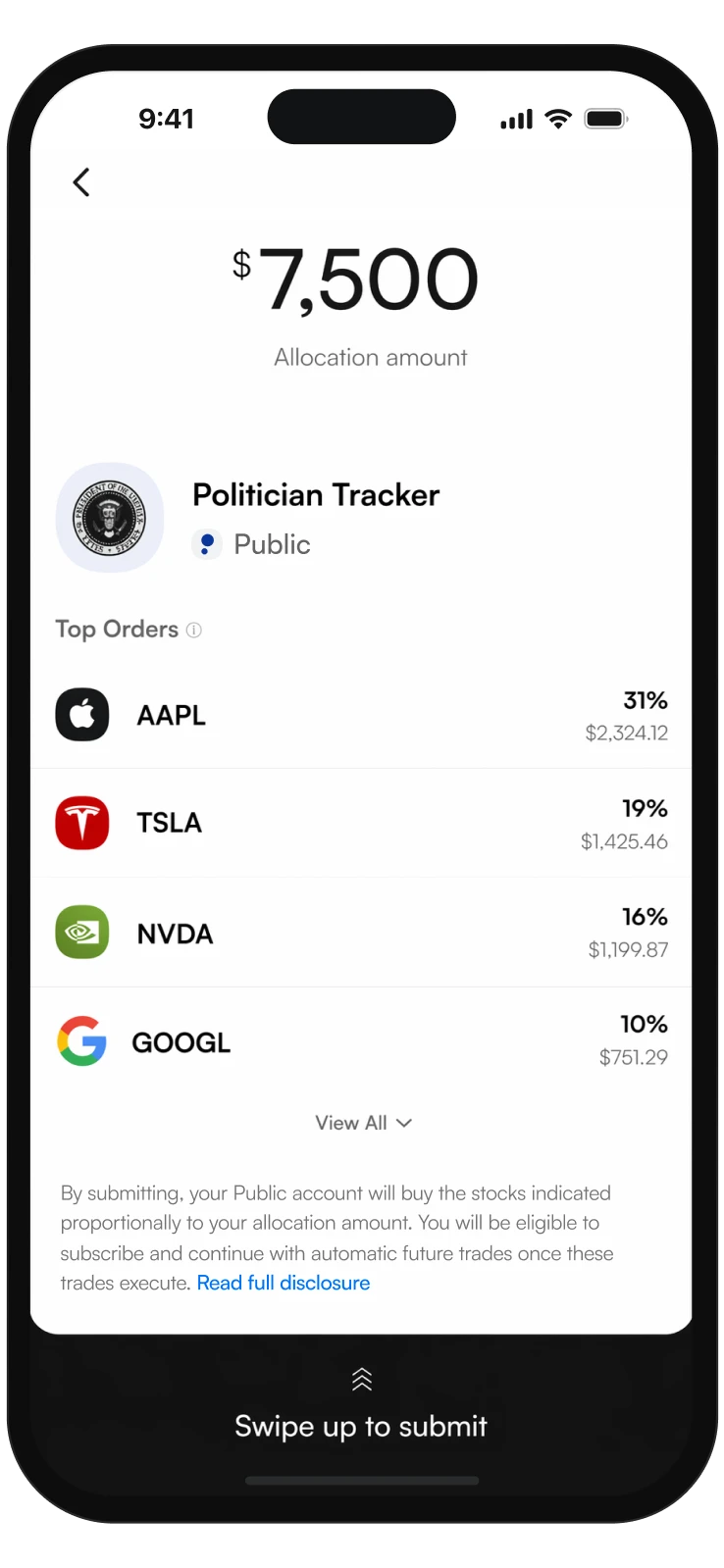
Your Portfolio is a set of weights. Each follower gets those weights applied to whatever they allocated. A follower with a small allocation holds smaller positions in the same direction, not your share counts.
Two things follow from that. Small positions in your Portfolio become tiny orders in small accounts, and orders under a minimum size don't happen. So a Portfolio with fifty two-percent positions leaves small followers holding a fraction of it, with the rest in cash.
And brokerages differ on fractional shares. Whole-share brokerages can only approximate your weights, and a high-priced stock at a small weight gets skipped entirely. Fewer, larger positions follow more faithfully across account sizes than many small ones.
2) Every change is orders
When you change the Portfolio, we send the orders and each follower's broker fills them.
So a Portfolio you rebalance daily produces daily orders in every follower's account, with all the timing differences, rounding, and settlement waits that come with them. In taxable accounts, every sale is a taxable event on your schedule, not theirs. A Portfolio you change a few times a quarter produces a few clean events.
Neither is wrong. The frequency is a real property of your product, and the description should say what to expect. One of our Pilots writes "very actively traded" in his first sentence, which is exactly right.
3) Followers lag you, always
You're never trading at the same moment as your followers. Orders go out after you change the Portfolio. Brokers fill them at their own pace. Some brokerages make the follower approve each trade first. Some followers have unsettled cash.
Your followers' results will differ from your Portfolio's, and our disclosures say so. Design for it. A strategy whose edge depends on the exact minute of execution doesn't survive the lag. A strategy whose edge is what to own over weeks and months does.
4) Concentration is a promise
Your Portfolio's holdings are visible in the app. If your Portfolio is five names, followers will see that, and they should. A concentrated Portfolio is a legitimate product, and the record will tell the story either way.
What doesn't work is a description that says diversified above holdings that show three positions carrying everything. Match the words to the weights.
5) Writing the description
Your description and bio show up in the app verbatim, next to your record. Say what the Portfolio owns and why, in one or two paragraphs. Say how often it changes. Say who it's for and who it isn't. If the risk is high, say so in the first sentence.
Leave out returns, targets, and comparisons to an index. That's what the record is for. The best descriptions on the platform read like a sober friend explaining the bet.
Quote
Concentration is a promise you make to people who cannot see what you see.
Conclusion
The rules for talking about it
Four rules, and they protect you as much as your followers.
No promises about results, anywhere. Not in the description, not in your posts, not in a reply. The record in the app, computed from actual follower accounts, is the only performance claim your Portfolio makes.
No promises of any kind. Nothing that says the Portfolio can't lose, and nothing that says it will do better than the market.
No personal advice to followers. You publish a Portfolio for anyone who chooses it. Telling a specific person what to do with their money is a different activity with different rules, which is exactly why Autopilot Advisers, LLC sits between you and them.
And your description is marketplace text, not a recommendation. Write it as a description of what the Portfolio does, not a pitch about what it will do for someone.
The test for any sentence: would you be comfortable seeing it printed next to your worst month?
TLDR: Stocks and ETFs only. Following is proportional, so fewer, larger positions follow better. Every change is orders in every account, so say how often you change things. Followers lag you, so design for weeks, not minutes. Match the description to the weights, leave the results to the record, and never promise anything.
FAQ
How should a Pilot write a Portfolio description?
Plainly, since it shows up in the app verbatim next to the record. Say what the Portfolio owns and why, how often it changes, who it's for and who it isn't, and label the risk if it's high. Leave out returns, targets, comparisons to an index, promises of any kind, and anything aimed at a specific person's situation. The record shows results. The description is marketplace text, not a recommendation.
Why don't my followers' accounts match my Portfolio exactly?
Because following is proportional to each follower's allocation, orders go out after your change and fill at each broker's pace, some brokerages require follower approval or trade whole shares only, small positions fall under minimum order sizes, and some followers have unsettled cash or joined on a different day. Our disclosures state these differences. Fewer, larger positions reduce them.
How does rebalancing frequency affect my followers?
Every change to your Portfolio becomes orders in every follower's account, sent by Autopilot Advisers and filled by each follower's broker. Frequent changes mean more orders, more timing and rounding differences, more settlement waits, and in taxable accounts more taxable events on your schedule. Infrequent changes mean fewer, cleaner events. Say in your description how often the Portfolio changes.
What can a Pilot include in a Portfolio on Autopilot?
Stocks and ETFs, held long, because that's what Autopilot can trade in a follower's brokerage account. Options, crypto, and short positions can't be followed. A view on a sector like crypto can be expressed through companies and ETFs tied to it. Portfolios should be built to be followed safely at scale, which favors fewer, larger positions over many small ones.
Related Articles


Disclosures
Since Autopilot Advisers is an SEC-registered investment adviser, we have to put disclaimers on stuff like this. They're below, and the full version is on our legal page.
© Autopilot Holdings Corporation 2026 — All rights reserved. “Autopilot” refers to Autopilot Holdings Corporation and its wholly-owned, and separately managed subsidiaries, including Autopilot Advisers, LLC, an SEC-registered investment adviser. All investing is subject to investment risks, including possible loss of the principal invested, and past performance is not indicative of future results. View our Customer Relationship Summary and other important information at joinautopilot.com/legal.
This information is provided by Autopilot for educational and illustrative purposes only and is not a recommendation, an offer to sell or the solicitation to buy any security. Autopilot relies on information from various sources believed to be reliable, including information from Clients, Pilots and other third parties, but cannot guarantee the accuracy or completeness of that information. Autopilot does not provide tax or legal advice and you are encouraged to consult with professionals before making investment decisions.
Autopilot is not affiliated with, sponsored, or endorsed by the companies listed, described, or featured on its site. Company logos or trademarks used do not imply endorsement and are the property of their respective owners.
Investing involves risk, including the possible loss of principal. Past performance does not guarantee future results. You should carefully consider your investment objectives, risk tolerance, and time horizon before investing through Autopilot.
Autopilot Advisers, LLC is an SEC-registered investment adviser. Registration as an investment adviser does not imply a certain level of skill or training. Additional information about Autopilot is available in our Form ADV Part 2A, available at adviserinfo.sec.gov or joinautopilot.com/adv.
Autopilot provides limited investment advisory services focused on Portfolio selection and suitability assessment. Our services are not intended to replace comprehensive financial planning. We recommend consulting with a qualified financial advisor regarding your complete financial situation.
This content is provided for educational and informational purposes only. It does not constitute investment, legal, or tax advice and should not be relied upon as the basis for any investment decision. You should consult with qualified professionals regarding your specific circumstances.
Autopilot does not provide tax, legal, or accounting advice. You should consult with qualified tax and legal professionals regarding your specific circumstances.
Autopilot does not hold client assets. All investments are held at the brokerage firm you select and connect to Autopilot. Your brokerage firm is responsible for trade execution, custody, and reporting. Autopilot is not responsible for your broker-dealer’s services, fees, or execution quality.
Autopilot’s services depend on technology systems, third-party APIs, and internet connectivity. System outages, API disruptions, or connectivity issues may temporarily affect service availability or trade execution timing.
Client account holdings are designed to track the Portfolio you’ve selected, but your actual holdings and performance may differ from the Portfolio due to execution timing, market conditions, brokerage capacity constraints, fractional share availability, and other factors outside Autopilot’s control.
For Portfolios inspired by publicly disclosed trading activity, there may be a delay between when a Pilot executes a trade and when that trade becomes publicly available and is incorporated into the Portfolio. This timing delay may affect the suitability or performance of trades when executed in client accounts.
This page is for prospective Pilots. Pilot compensation is described as stated in Autopilot's public help center; the revenue split is not published and no level of revenue is promised. The conflicts described are from Autopilot's own disclosures. Third-party Pilots are independent and are not investment advisers to followers; Autopilot Advisers, LLC is the manager of every Portfolio. Nothing here is a performance claim or a recommendation.